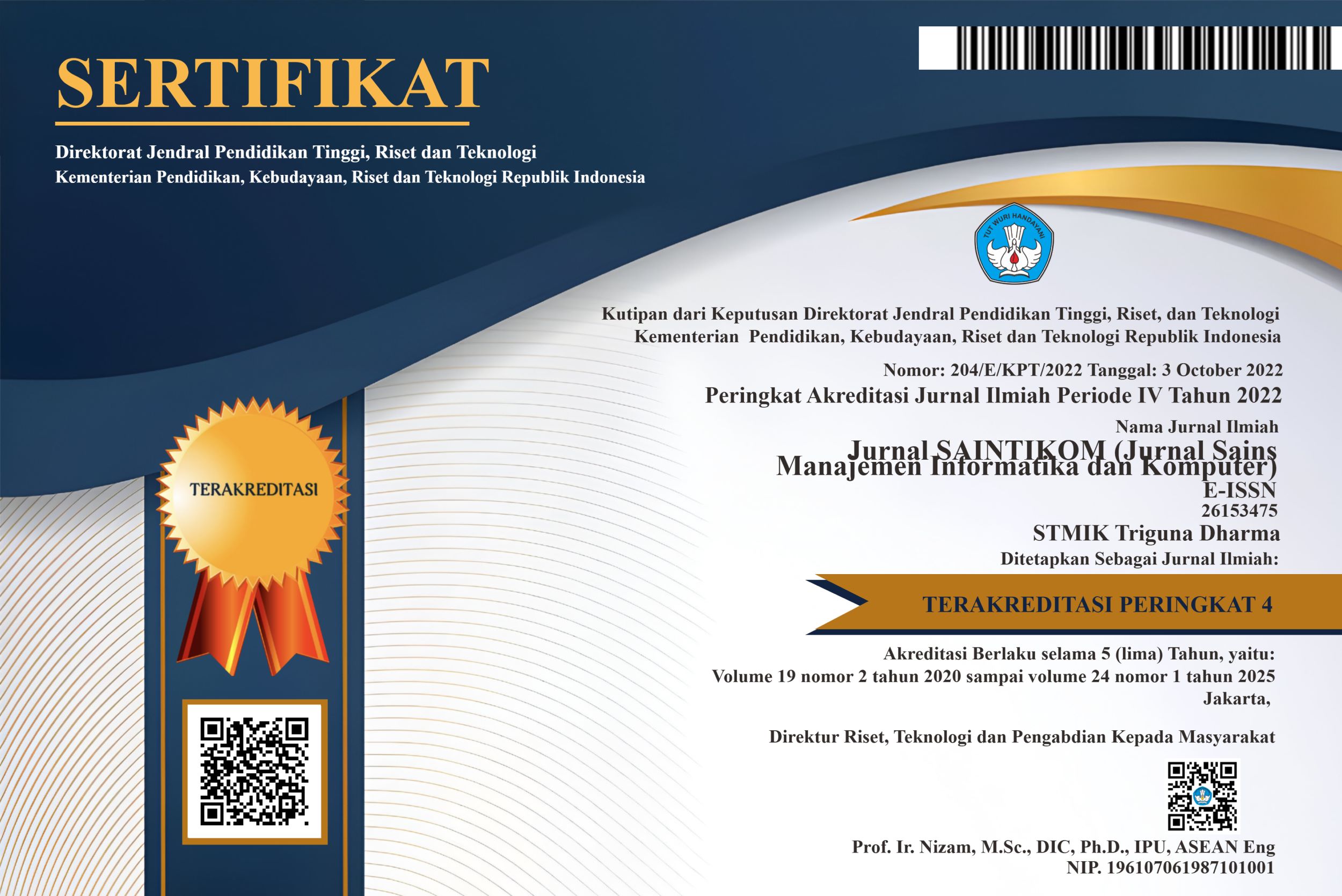
Akreditasi Nomor: 36/E/KPT/2019

MENU
JOURNAL TEMPLATE

ISSN


INDEXING








STATISTICS
This policy outlines the journal’s position on the ethical and responsible use of Generative Artificial Intelligence (GenAI) and AI-assisted technologies in the preparation, submission, review, and publication of manuscripts. The policy aims to promote transparency, accountability, academic integrity, and the reliability of the scientific record. The use of AI should support authors’ work without replacing their intellectual contribution, critical judgment, or responsibility for the submitted manuscript.
1. Authorship and Accountability
AI Cannot Be an Author: AI tools and AI-assisted technologies, including Large Language Models (LLMs) and Generative AI systems, cannot be listed as authors or co-authors because they cannot assume responsibility for the content, integrity, originality, or ethical aspects of a manuscript.
Authors’ Full Responsibility: Authors remain fully responsible and accountable for the entire content of their manuscript, including any text, ideas, analyses, references, data, figures, or other materials produced or assisted by AI tools.
Human Oversight Required: Any material generated or modified using AI must be critically evaluated, verified, edited, and approved by the authors before submission. Authors must ensure that the final manuscript meets appropriate standards of accuracy, originality, academic quality, and research ethics.
2. Permitted Use of Generative AI
Authors may use GenAI tools to support manuscript preparation, provided that their use does not compromise academic integrity. Permitted uses may include:
a. improving grammar, spelling, punctuation, and language clarity;
b. translating text between languages;
c. improving the readability and organization of academic writing;
d. assisting with brainstorming or generating preliminary ideas;
e. assisting with formatting or structuring content;
f. providing suggestions for improving the presentation of arguments or explanations; and
g. assisting with other routine editorial or language-related tasks.
The use of AI for these purposes does not transfer responsibility for the manuscript from the authors to the AI tool.
3. Disclosure of AI Use
Authors must transparently disclose the use of GenAI when it has materially contributed to the preparation or development of the manuscript. The disclosure should identify the AI tool used and briefly describe how it was used.
Minor uses of AI-assisted tools for routine spelling, grammar, punctuation, or formatting corrections may not require disclosure unless otherwise required by the journal.
Any required disclosure should be included in the appropriate section of the manuscript or at the point specified by the journal’s submission system.
4. Verification of AI-Generated Content
Authors must carefully verify all content generated or assisted by AI. This includes, but is not limited to:
a. factual statements;
b. statistical results and calculations;
c. citations and bibliographic references;
d. quotations;
e. scientific claims;
f. data and interpretations;
g. figures, tables, and captions; and
h. descriptions of methods or experimental procedures.
AI systems may generate inaccurate, incomplete, misleading, or fabricated information. Authors are therefore responsible for independently checking the accuracy and authenticity of all AI-assisted content before submission.
5. Originality and Academic Integrity
The use of GenAI must not result in plagiarism, duplicate publication, fabrication, falsification, misrepresentation, or any other form of academic misconduct. Authors must ensure that AI-assisted content does not improperly reproduce copyrighted or previously published material.
Authors must also ensure that appropriate citations and acknowledgements are provided for ideas, data, text, images, or other intellectual contributions originating from sources other than the authors.
6. Prohibited Uses of Generative AI
The following uses of GenAI are not permitted:
a. generating or fabricating research data, experimental results, or statistical findings;
b. creating or manipulating evidence in a manner that misrepresents the research;
c. generating fictitious or unverifiable references or citations;
d. using AI-generated content without appropriate verification;
e. presenting AI-generated ideas, text, analysis, or other material as entirely the authors’ own intellectual contribution when disclosure is required;
f. using AI to conceal plagiarism or other forms of academic misconduct;
g. using AI to manipulate images, figures, or research materials in a misleading manner; and
h. submitting content generated by AI that has not been adequately reviewed and verified by the authors.
7. Confidentiality and Sensitive Information
Authors should exercise caution when entering manuscript content, unpublished data, personal information, confidential information, or proprietary materials into external GenAI systems. Authors must ensure that the use of AI tools does not violate confidentiality obligations, research participant protections, intellectual property rights, or applicable data protection requirements.
8. Use of AI by Editors and Peer Reviewers
Editors and peer reviewers must maintain the confidentiality of submitted manuscripts and must not upload unpublished manuscripts, reviewer reports, or other confidential materials to public or third-party GenAI systems unless the journal has explicitly authorized such use and appropriate safeguards are in place.
AI tools must not be used as a substitute for the professional judgment, expertise, or decision-making responsibilities of editors and peer reviewers. Editorial and peer-review decisions must remain under appropriate human oversight.
9. AI-Assisted Images, Figures, and Other Visual Materials
The use of AI to generate or substantially modify images, figures, illustrations, or other visual materials must be clearly identified when such use is relevant to the research or presentation of the manuscript. Authors must ensure that AI-assisted visual materials do not misrepresent research findings, alter evidence inappropriately, or violate copyright, licensing, or other intellectual property rights.
AI-generated images must not be presented as authentic research evidence when they do not represent actual observations, experimental results, or source materials.
10. Editorial Assessment and Compliance
The journal reserves the right to request clarification regarding the use of GenAI at any stage of the publication process. Authors may be required to provide additional information about how AI tools were used in the preparation of their manuscript.
Failure to disclose material AI use, misrepresentation of AI-generated content, fabrication of information, or other violations of this policy may be considered a breach of publication ethics and may result in appropriate editorial action in accordance with the journal’s publication ethics policies.
11. Policy Updates
This policy may be periodically reviewed and updated to reflect developments in Generative AI technology, research ethics, publishing standards, copyright regulations, and recommendations from relevant scholarly and publishing organizations. Authors, editors, reviewers, and other contributors are expected to comply with the version of this policy applicable at the time of their participation in the publication process.